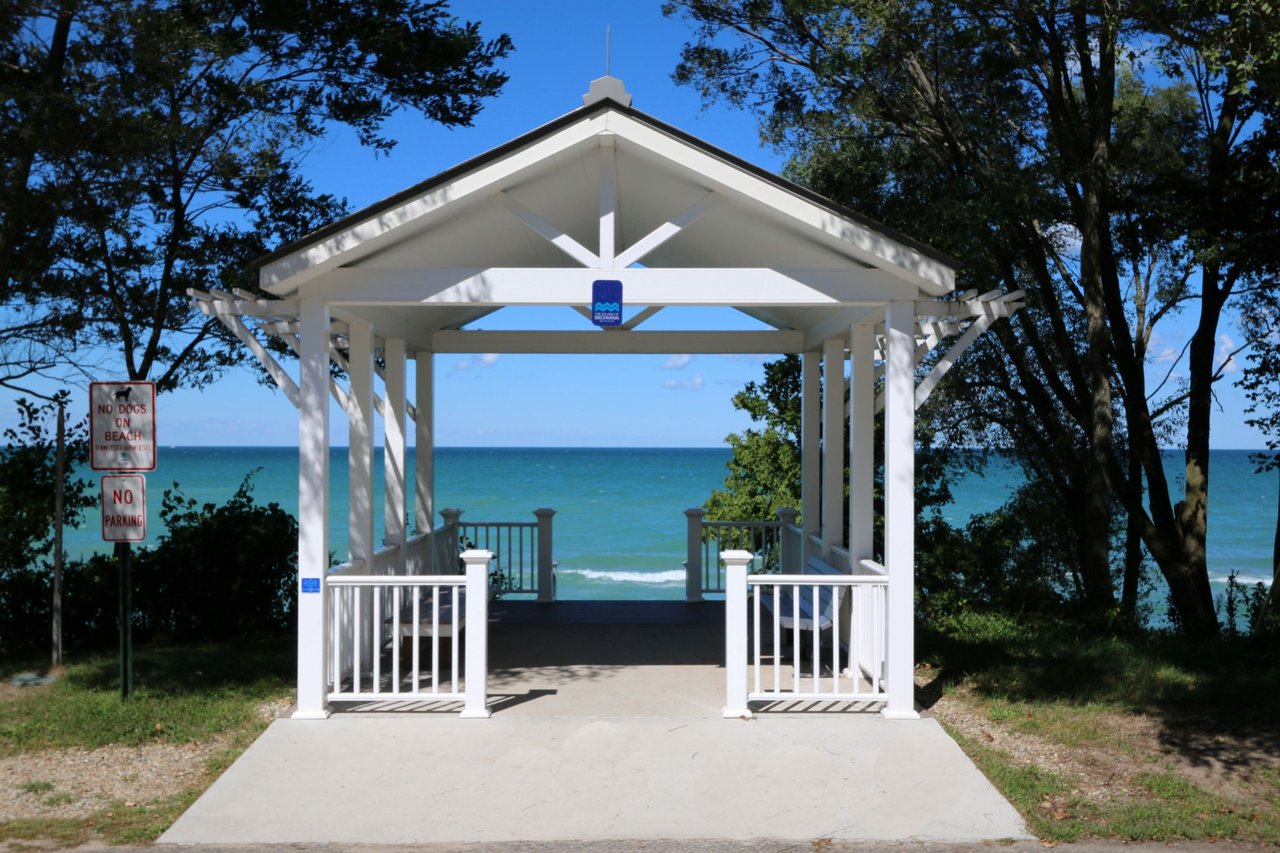
Anyone who has spent a full season in the Village of Michiana knows the place runs on a small stack of ordinances that read like housekeeping and behave like infrastructure. Tag pricing at Stop 41. A sticker for the cart. A window of hours when the dog can be on the sand. Permit slips for the fire pit. None of it is dramatic on paper, and none of it appears in the brochures.
The thesis is simple. Michiana is not organized by weather or weekends. It is organized by a handful of village rules that quietly decide who ends up where, and when. Learn the stack and the village feels roomier than the map suggests. Miss one line item and the same village feels small in a way no acreage can fix.
The Stop 41 tag economy
Stop 41 is the village's main beach access, and the parking there is not first-come. The rule, published in the Village of Michiana FAQ, is that homeowners buy tags on a tiered structure and display them on the dashboard or from the rearview.
Item | Cost | Notes |
|---|---|---|
First two parking tags | $20 each | Valid April 1 through the following March 30 |
Each additional tag | $50 | Same validity window |
Golf cart sticker | $20 | Required to park a cart in the Lake Shore Drive area near Stop 41 |
Overflow | Free at Village Hall | No overnight parking without a Grand Beach/Michiana officer's approval |
Read the pricing carefully. The first two tags share a price with the cart sticker, and the third tag costs more than two-and-a-half times what the second one did. That is not a rounding quirk. It is a soft cap on how many vehicles a single household is expected to route to the beach, and it is the reason the third car in a rented weekend house tends to sit at the house while everyone else piles into a cart or walks. The stack is not designed to raise revenue. It is designed to keep Stop 41 legible on an August Saturday.
What the cart sticker actually buys
A $20 golf cart sticker is the cheapest infrastructure a Michiana household will ever buy, and it is the one that reorganizes the day. It legalizes cart parking in the Lake Shore Drive area near Stop 41, and it slots you into a state framework that lets small municipalities allow cart use on local streets at all. The enabling statute, MCL 257.657a, caps cart speed at 15 mph, bans operation from a half hour before sunset to a half hour after sunrise, and requires a licensed driver at least 16 years old.
Two consequences follow that most first-summer owners do not see coming.
First, the sunset restriction means a cart is a daytime and early-evening tool, not a night one. Dinner at Stop 50 Wood Fired Pizzeria or an ice cream run in Michiana Shores is a cart trip if you leave early enough. A late reservation is a car trip.
Second, the village speed limit is 25 mph across every street. That collapses the practical gap between a cart and a sedan for anything inside Michiana proper, which is why the cart wins on convenience even when it loses on speed.
Three clocks residents keep in their heads
The dog clock
Under village ordinance, no dogs are allowed on the beach between 11 a.m. and 6 p.m. from Memorial Day through Labor Day, and dogs must be leashed at all times under Michigan law. That window is why the dog-owning half of the village walks the beach at 7 a.m. and again after dinner, and why the rental families who show up at noon with a golden retriever get gently redirected.
The construction clock
Construction noise is restricted to Monday through Friday, 8 a.m. to 5 p.m.; Saturday, 10 a.m. to 5 p.m.; and no construction noise on Sundays or holidays. If you are trying to plan a July closing with a punch list, that Sunday zero is the line item that keeps slipping the timeline. A contractor who cannot Sunday around a July 3 holiday cannot Sunday around a July 3 holiday.
The fireworks clock
Fireworks are always illegal in the Village of Michiana on all public lands and beaches; they are permitted on private property only under regulations and dates set by the State of Michigan. Fines for any violations are $1,000. Renters are not allowed to use fireworks at any time in the village.
Two things are worth reading twice there. The $1,000 fine is per violation, not per household. And the renter prohibition is absolute, which is the single most-underestimated line item for anyone thinking about the short-term rental economics of a Michiana cottage. A property that cannot host a Fourth of July fireworks display for its renters prices differently than one across the county line that can.
Stop 37, the shared border
The village line does not run where a map user would expect. Stop 37 sits mostly in Michigan and is part of the original 600 or so acres the Long Beach Company sold off to form both Michiana, Michigan and Michiana Shores, Indiana. The Village of Michiana shares the stop with the Town of Michiana Shores and assists in its maintenance.
That shared parentage is why the two Michianas feel like one place and read like two on the tax rolls. It is also why a bonfire on the sand at Stop 37 requires a permit from the Village of Michiana on the Michigan side, even if the house you rented is a five-minute walk south into Indiana. The permit follows the sand, not the driveway.
Where dinner actually fits
The village has no restaurants of its own, so the dinner map is a radius, not a list. Inside a fifteen-minute cart-and-car window:
- Stop 50 Wood Fired Pizzeria in Michiana Shores runs a 900-degree hearth for Neapolitan pies and is the default weeknight destination for households that do not want to leave the Michiana footprint.
- Duneland Beach Inn and its Farina's Supper Club occupy the sit-down anniversary slot, with Chef Farina's signature Pork Chop Sinatra and a supper-club cocktail bench that leans old-school.
- Bartlett's Fish Camp, profiled in Edible Michiana, is the boat-in oyster bar at the mouth of Trail Creek and one of the few raw bars in Northwest Indiana.
- Bentwood Tavern at Marina Grand and the Terrace Room inside the Harbor Grand handle the New Buffalo waterfront register.
- Brewster's covers the year-round breakfast-and-modern-Italian slot in downtown New Buffalo.
None of these are inside the village, and that is the point. The village trades restaurant density for beach frontage, and the ordinance stack is what protects the trade.
The other radius
The cart's second job is to reach the two civic amenities most residents underuse in their first summer. The Grand Beach Golf Course is a nine-hole public course laid out by Tom Bendelow and open since 1912, which makes it older than most of the cottages that sit around it. Michiana Village Park, a few blocks from the lake, has pickleball courts that fill up on weekday evenings in a way the beach does not.
Neither shows up on the standard visitor itinerary, and both are quietly why the shoulder season, September through mid-October, is the village's best-kept stretch of the year.
When the season turns
Labor Day flips the dog clock off. The tags stay valid through March 30, which means the last cart runs to the beach happen on cool October afternoons with a jacket in the seat well. The construction hours are the same, but the Sunday quiet reads differently once the summer households have closed up. The rulebook does not change. The population it governs does.
That is the reading a resident earns by August. The village is not a set of amenities that happen to sit near a lake. It is a small piece of civic machinery that keeps a stretch of Lake Michigan shoreline usable at a scale that would not survive without the stack.
If you own in Michiana and are starting to think about what your cottage looks like on the other side of the season, Shoreline Advice is happy to sit down and talk through valuation, timing, and what the local rulebook means for how your property presents to the market.