Every summer, before anyone posts a flyer or sends an email blast, someone in Long Beach threads red Solo cups through a chain-link fence along Oriole Trail. The cups spell out nothing in particular. They just catch the eye, in the way a homemade sign does, and residents who've lived here a while know exactly what it means: Art in the Park is coming, and the cups will be gathered up afterward and driven to the Solid Waste District of La Porte County to be recycled once the show closes.
It's a small, unpaid gesture that tells you more about how this town actually works than anything on a town council agenda. Long Beach doesn't have a business district big enough to hang a banner across, so a resident wove one out of party cups instead. That instinct, make do with what's here, keep it local, let volunteers carry the weight, runs through almost everything that holds this place together. And it mostly runs through one building.
A Town Built to Stay Small
Long Beach was incorporated in 1921 as a resort town, named for its stretch of Lake Michigan sand, and it has never tried to be more than that. The 2020 census counted 1,189 residents. The town has a five-member council, a clerk treasurer, a police department, a volunteer fire department, and a parks department, and that's the entire municipal apparatus for a place with a private golf course and country club, the Long Beach Country Club, but no real commercial strip to speak of.
Most homes here run on septic systems rather than sewer lines, sewer and sidewalk coverage is thin across town, and the water that does reach taps is purchased from neighboring Michigan City rather than treated locally. That's not a complaint. It's a structural fact that shapes what infrastructure conversations even look like here. When the town's own newsletter recently announced that the main paving phase of its community infrastructure project was about to begin, that single paving push is a meaningful capital event for Long Beach in a way it would never be for a town with a larger public works budget.
One Address Does Many Jobs
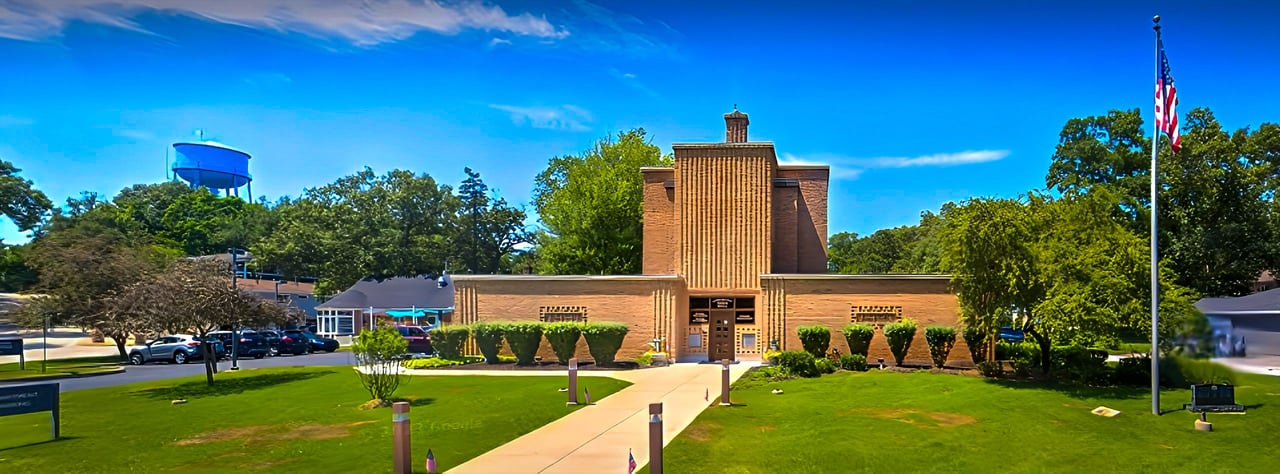
If Long Beach has a civic hub, it's the Old School Community Center at 2501 Oriole Trail, a former Long Beach schoolhouse now doing the work of a town hall annex, art museum, meeting space, and general gathering point. The building houses the Harbart and Lake's Edge Galleries, which rotate contemporary work from artists across the Michiana region, so the same hallway that once held lockers now holds gallery openings. On Monday nights, the same building hosts an Alcoholics Anonymous meeting. The Park Board runs recurring art classes out of it. When the town needs a venue for a Holiday Market of local vendors selling handmade goods, this is where it happens.
None of that is unusual for a small town. What's unusual is how little redundancy there is. There's no second building absorbing the overflow, no community college annex or library branch splitting the load. One converted schoolhouse just down Oriole Trail from town hall is doing the job that would take three or four separate institutions in a larger municipality. If you've ever wondered why the same building keeps showing up in every flyer, that's why.
The Fire Department Runs the Summer
Ask a Long Beach resident what actually structures the calendar and the answer usually isn't a town ordinance. It's the fire department. The Long Beach Fire Department hosts the Ice Cream Social, described on the town's own events page as a long-standing tradition where residents show up for refreshments and time with local first responders. The same volunteer infrastructure carries Trunk-or-Treat, jointly run by the police and fire departments every Halloween, where residents decorate vehicles and hand out candy in a controlled, family-friendly setup.
The summer's biggest date, the Fourth of July, works the same way. The town's parade, activities, and fireworks are described as made possible through community organizations and volunteers, not a hired events company, and the Old School Run, a community run and walk open to all ages, is timed to happen alongside the holiday rather than as its own separate weekend.
Layer in the rest of the year's rhythm and you get a short list that covers almost everything residents actually do together:
- The Ice Cream Social, hosted by the Fire Department
- The Fourth of July parade, activities, and fireworks
- The Old School Run, held alongside Independence Day
- The annual Beach Clean-Up, where volunteers clear litter and debris from the shoreline
- Art in the Park, with its open house at the Community Center
- The Holiday Market, featuring local vendors and handmade goods
Every one of those is organized by volunteers or by the town's smallest departments. There's no parks and recreation staff of dozens, no dedicated events office. It's the same handful of people and the same building, over and over, all year.
The Houses Explain Themselves, If You Know Who Built Them
Long Beach's residential character isn't an accident either. John Lloyd Wright, son of Frank Lloyd Wright, lived in Long Beach and established his own architectural practice here, designing a number of the houses that still stand in the area. If certain streets in town have a family resemblance in their rooflines or their proportions, that's not a coincidence of era. It's the fingerprint of one architect working repeatedly in one small place.
Three homes carry that history formally. The Hoover-Timme House, built in 1929, the John and Isabel Burnham House from 1934, and the Lowell E. and Paula G. Jackson House from 1938 were all listed on the National Register of Historic Places in 2013. That's a meaningful cluster of federally recognized architecture for a town this size, and it tells you something about the caliber of design that showed up here in the 1920s and 30s, back when Long Beach was still mostly a Chicago summer escape rather than a year-round address.
A Notable Connection
The town's Wikipedia entry notes that Dag Kittlaus, known as a founder of Siri, has ties here.
That connection has nothing to do with real estate value, and it shouldn't. Long Beach is a town of barely 1,200 people, with no downtown, thin sewer coverage, and a five-person council. The Old School building still serves as a civic hub. The fire department still runs the Ice Cream Social. The paving project is still treated like the year's biggest capital news. Scale never caught up with substance here, and that gap is arguably the most honest description of what Long Beach actually is.
If you're weighing a change of address within Harbor Country, or you just want a straight read on how a town like this actually functions day to day, Shoreline Advice spends its time in these details because they're the ones that matter once you're living here, not just visiting. Request a Free Home Valuation and start the conversation with Rob Gow and Chris Pfauser.