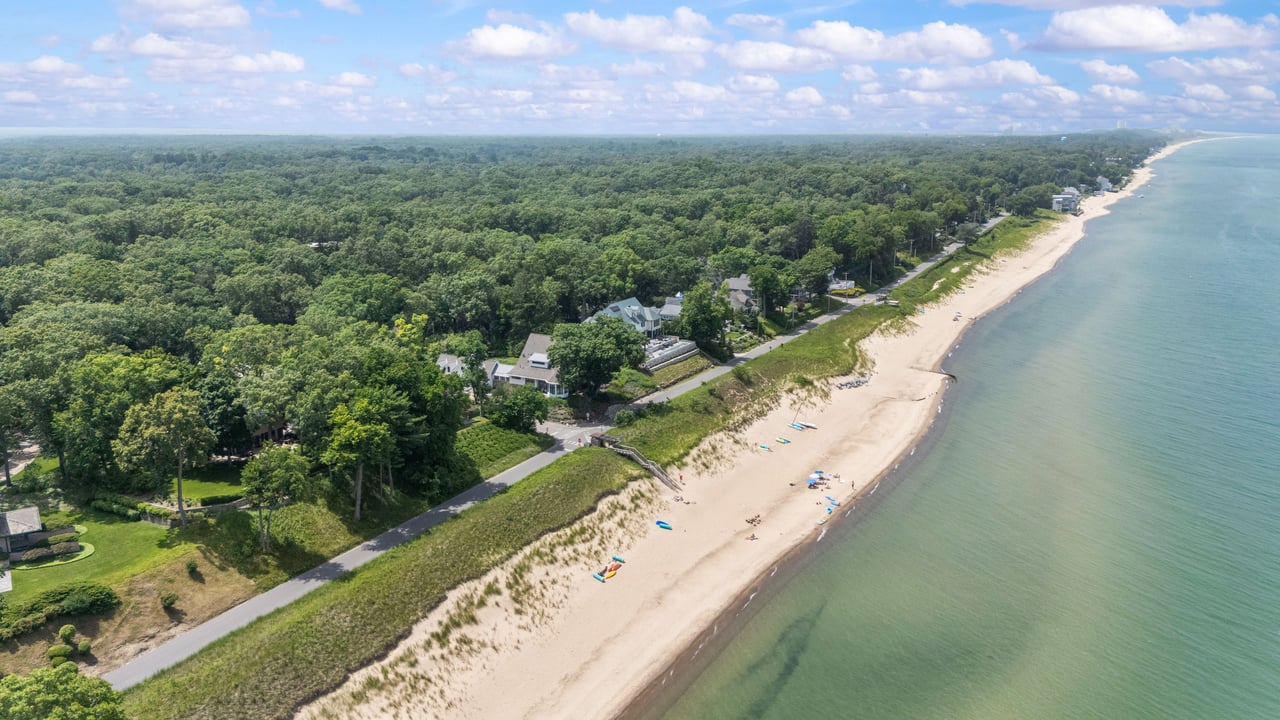
If you are drawn to Duneland Beach, you are probably not just looking for a house near the water. You are looking for a very specific kind of Lake Michigan ownership experience, one that blends shoreline beauty with structure, seasonality, and real neighborhood responsibility. Understanding that balance can help you decide whether this community truly fits your lifestyle. Let’s dive in.
Duneland Beach Feels Tucked Into a Larger Shoreline
Duneland Beach sits within the Indiana Dunes shoreline corridor between Gary and Michigan City, roughly 50 miles southeast of Chicago. That location gives it a connected feel, not the feeling of a stand-alone resort town cut off from everything around it.
You are part of a broader lakeshore network that includes Beverly Shores and Indiana Dunes State Park. The result is a setting that feels residential and tucked away, while still being shaped by the energy of the surrounding Indiana Dunes area.
The landscape itself is a big part of the experience. According to the National Park Service, this shoreline is defined by active dunes formed through the interaction of Lake Michigan and the shore, and the broader park includes more than 1,100 native plant species and 50 miles of hiking trails.
That matters because ownership here does not feel manicured in a resort-style way. It feels close to a living natural system, where sand, wind, vegetation, and lake conditions all play an ongoing role in daily life.
Beach Life Has a Clear Rhythm
In Duneland Beach, beach access feels organized rather than casual. The homeowners association directs residents to use designated beach stops to help protect the dune, and the association identifies stop captains for stops 32 through 36.
That system gives shoreline life a distinct rhythm. Instead of treating the beach like one long, open edge, the community uses defined access points that reflect both stewardship and routine.
There is also a clear seasonal reset. Association letters say boats and other items left on the beach must be removed by October 31, which reinforces the idea that the shoreline is actively managed, not simply left to evolve on its own.
The wider Indiana Dunes beach system adds to that cadence. Beach parking lots in the broader area open at 7:00 a.m. and close 30 minutes after sunset, while cyclists and hikers can enter at 6:00 a.m.
You also need to keep expectations realistic around swimming conditions. The National Park Service notes that waves, rip currents, and water quality can change quickly, and swim areas at West Beach may close when wave conditions or E. coli levels are high.
Duneland Beach is also part of Indiana’s beach monitoring system as Duneland Beach Stop 34 in LaPorte County. That is a useful reminder that shoreline living here comes with active public monitoring and lake-based variables that can shift from day to day.
Ownership Here Is Hands-On
One of the clearest truths about Duneland Beach is that it is not a low-maintenance ownership experience. The association lists committees covering beach security, roads, water, real estate, garbage and recycling, park maintenance, finance, and rules and regulations.
That tells you a lot about how the community functions. Ownership here involves systems, oversight, and shared expectations, not just private enjoyment of a beach setting.
Utilities and services reflect that same structure. The community’s consumer confidence report says Duneland Beach purchases all of its water from Michigan City’s water works, which shows how even essential infrastructure is part of a managed framework.
Day-to-day maintenance also follows a schedule. Association guidance says garbage is collected every Monday, recycling runs every other week until Memorial Day, and fall leaf pickup happens in multiple passes before snowfall.
Those details may sound small, but they shape how the neighborhood feels. In practice, they create a place where upkeep is visible, routine, and part of the ownership culture.
Rules Shape the Experience
For some buyers, rules feel restrictive. In Duneland Beach, they are better understood as part of the community’s operating model.
Association letters state that short-term rentals of less than one month are prohibited. Real estate transfers require association paperwork, and remodels or additions need board approval.
If a project requires heavy equipment or a dumpster, the association requires a $6,000 road bond. That requirement signals that the neighborhood is serious about protecting shared infrastructure during construction activity.
Taken together, these rules create a more structured ownership environment. If you value predictability, stewardship, and a private-feeling lakeshore setting, that structure may feel reassuring.
If you prefer a more flexible or anonymous beach community, it may feel more involved than expected. That is why understanding the rules before you buy is so important.
The Community Expects Participation
Duneland Beach appears to operate with a strong sense of neighbor responsibility. Association guidance asks residents to watch for suspicious activity, return trash cans after pickup, and communicate with one another.
That language says a lot about the culture. You are not just buying a home near Lake Michigan. You are stepping into a community that expects owners to help maintain order, appearance, and awareness.
In many ways, that is what gives Duneland Beach its private-feeling character. The atmosphere is shaped not only by dunes and beach stops, but also by shared follow-through from the people who own there.
Summer Energy, Year-Round Stewardship
The Indiana Dunes area has long had roots in seasonal housing. The National Park Service says early accommodations included tents, summer cottages, cabin rentals, and rooms in private homes, and that seasonal homes once predominated before many cottages were winterized and later became permanent residences.
That history still shows up in Duneland Beach today. In summer, the shoreline setting naturally takes center stage, but the neighborhood’s systems show that ownership extends well beyond peak beach season.
The rules around rentals, beach items, utility oversight, trash service, and leaf pickup all support that idea. This is a place that may feel especially vibrant in warm weather, yet it remains organized for year-round care.
A deer-maintenance program developed with Indiana DNR participation runs from October 1 to January 31. That is another sign that the neighborhood calendar does not stop when summer ends.
For many buyers, this is the key takeaway. Duneland Beach feels like part retreat, part responsibility, and part year-round neighborhood.
What Daily Life May Feel Like
So what does ownership actually feel like on the ground? It likely feels quieter and more residential than the broader Indiana Dunes visitor experience, even though you are still within a region that draws nearly two million visitors a year.
It likely feels natural and visually distinct because the dunes are active and the shoreline is part of a larger ecological system. You notice the setting, the weather, the season, and the condition of the lake in a more direct way.
It also likely feels more structured than many buyers first assume. The designated beach stops, association committees, seasonal deadlines, maintenance schedules, and project approvals all create a framework that shapes daily life.
For the right buyer, that is exactly the appeal. You get a shoreline community with a strong identity, a clear operating culture, and a setting that feels deeply tied to the Indiana Dunes landscape.
Who Duneland Beach May Suit Best
Duneland Beach may be a strong fit if you want a Lake Michigan property that feels residential, organized, and closely connected to nature. It can also appeal if you are comfortable with association rules and appreciate a community where stewardship is taken seriously.
You may especially value this setting if you want a second home or primary home that offers a private-feeling environment within reach of the greater Chicago orbit. The location within the Indiana Dunes corridor gives it a distinct blend of access and separation.
It may be less ideal if your goal is maximum flexibility for short-term rental use or a low-involvement ownership model. The community’s rules and routines suggest that buying here works best when you are ready to participate, not just occupy.
Why Local Guidance Matters
In a place like Duneland Beach, the details matter. Beach access patterns, association processes, rental limits, construction rules, and seasonal operations all shape the ownership experience in ways that may not be obvious from photos alone.
That is why local, research-driven guidance is so valuable when you are considering a shoreline purchase. You want to understand not only the home itself, but also how the community actually functions throughout the year.
If you are exploring Duneland Beach or comparing it with other Northwest Indiana shoreline communities, Rob Gow & Chris Pfauser can help you evaluate the fit with a clear, consultative approach.
FAQs
What is Duneland Beach like for year-round ownership?
- Duneland Beach appears to blend seasonal beach energy with year-round stewardship, supported by ongoing services, association oversight, fall cleanup, and off-season programs like deer management.
How does beach access work in Duneland Beach?
- Beach access is organized around designated stops, and the association asks residents to use those access points to help protect the dunes.
Are short-term rentals allowed in Duneland Beach?
- Association guidance says short-term rentals of less than one month are prohibited.
What should buyers know about remodeling in Duneland Beach?
- Remodels and additions require board approval, and projects using heavy equipment or a dumpster require a $6,000 road bond.
What makes Duneland Beach different from a typical beach town?
- Duneland Beach feels more like a managed, private-feeling lakeshore enclave within the larger Indiana Dunes corridor, with active dune stewardship, defined access points, and strong ownership expectations.